
Who gives all these f*cks on the London stage?
Alastair MacaulayFrom our critic in residence, Alastair Macaulay:
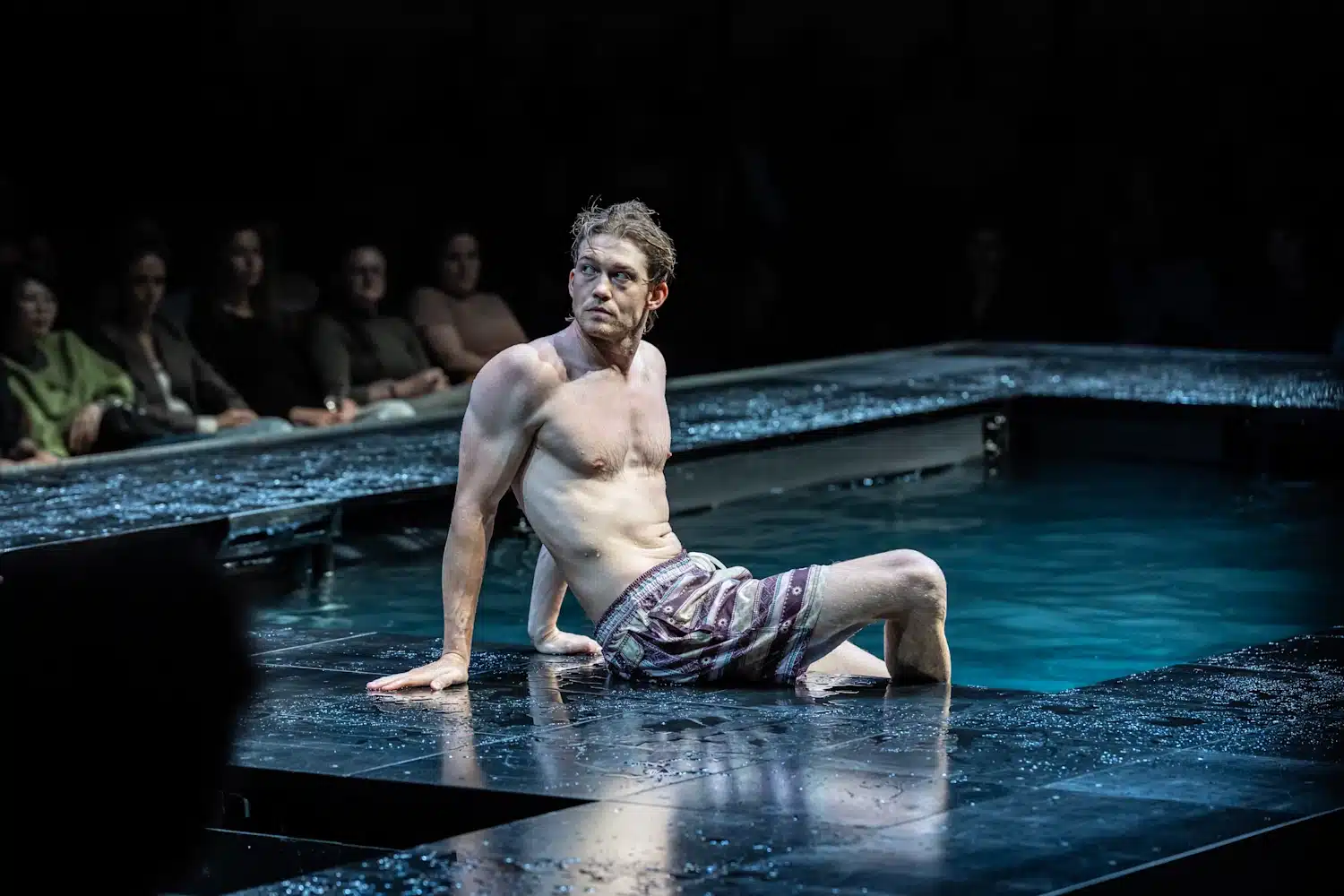
Sometimes it seems that world culture must have ended during our lifetimes and that what what we’re now watching is people lost amid the ruins. Witness “The Lady from the Sea”, at the Bridge Theatre (until 8 November). This is a play written and directed by Simon Stone “after Ibsen” – “after” in the sense that the Black Death was “after” the Roman Empire.
This “Lady from the Sea” is tough for those of us who have known Ibsen’s play to be a peak experience in live performance. In 1979, “The Lady from the Sea” was the play in which Vanessa Redgrave, as Ellida Wangel, gave what I long regarded as the greatest live performance I had seen in theatre, with the late Terence Stamp as the Stranger. Ibsen’s 1888 play was seen to be what it is: an infinitely subtle and poetic study of the psychosexual condition of a woman, Ellida, torn between the husband she knows and loves and the stranger from her past who blocks her willpower. Only when her husband gives her freedom to choose does she finds that he, rather than the Stranger, is her choice. In 2003, the same play was still very much alive when the Almeida Theatre reopened with Vanessa’s daughter Natasha Richardson playing Ellida Wangel (the cast included the young Benedict Cumberbatch) in Trevor Nunn’s production. I’ve also seen other, lesser productions – but ones in which this was still evidently a brilliant and living play.
There’s a whole family of Romantic dramas – including Hans Christian Andersen’s “Little Mermaid”, Tchaikovsky’s “Swan Lake”, Dvořák’s “Rusalka” – in which women and water are vitally if mysteriously linked. Ibsen’s “Lady from the Sea” belongs to that family. As Ellida goes through scenes with both the men in her life, Ibsen anticipates the work of Sigmund Freud. Apart from establishing the importance of a woman’s freedom to choose, he establishes the sea itself as a powerful but wonderfully ambiguous symbol, elementally important as long as Ellida cannot resolve the conflicts in her own mind.
Not so at the Bridge. Sure, Stone’s characters have the same names as Ibsen’s Norwegian originals – but they talk about iPhones and Spotify and going to Manchester. And they use the words “fuck”, “motherfucker”, “cunt” and “arsehole” far more often than Ibsen’s characters talk about the sea.
As Ellida, Alicia Vikander’s Ellida is a vividly prosaic character who shouts a lot and has full control of her own will from the start: she even turns out to have killed a man in the past (this is where Stone’s writing is at its most inept). At the end, she leaves her husband – which happens to be how Ibsen ended his earlier classic play, “A Doll’s House”, but is the opposite of how he ended this play. Peggy Ramsey, the legendary agent for many British playwrights, liked to say that dramatists should study “Ibsen, Ibsen, and Ibsen”. Stone, however, knows better. For him, Ibsen needs to be shouted, strewn with obscenities, and rewritten out of recognition. No thanks.
“The Lady from the Sea” had its premiere in 1888, the same year as “Creditors”, by the younger playwright August Strindberg. Like Ibsen, Strindberg was digging into the roots of male-female relationships: he includes disturbing elements of malice and misogyny that can make his plays even now both fascinating, painful, and raw. Fortunately for us, “Creditors” – which he recognised as the most mature play he had yet written in his prolific career – is alive and well at the Orange Tree Theatre in Richmond, in an exemplary, seemingly simple, production directed by Tom Littler (running until October 11).
Charles Dance, Geraldine James, and Nicholas Farrell are the three stars here, giving organic performances that develop as we watch. These three are forever linked to the great 1984 TV series of “The Jewel in the Crown”- but who guessed in 1984 that Dance would become a haunting conveyor of malice? Who knew the versatility that James would keep revealing? Or the open-hearted vulnerability with which Farrell keeps making himself surprising? Littler never imposes on Strindberg: he lets the power play between the characters evolve suspensefully.
The Almeida Theatre is showing (until October 11) something named “Romans, a novel”, by Alice Birch, which turns out to be a clumsy collage of several unalike scenes that might work better if they belonged to several separate novels and/or plays. It’s about three very different but very English twentieth-century brothers (“Roman” is their surname), all of whom were damaged by parenting and by boarding school, and at least two of whom become examples of what’s now labelled toxic masculinity. Sam Pritchard directs: it’s not his fault that the play falls apart into separate elements as you watch, though I wish he had staged it without amplification – the Almeida is, after all; an intimate space. As the three brothers, the actors Kyle Soller, Oliver Johnstone, and Stuart Thompson all take their characters on large arcs throughout the production (which lasts almost three hours). Thanks to Birch’s writing, however, “Romans” is less than half-baked. It’s another production that seems to have been composed after the end of world culture, in this case because of its sheer incoherence.
At the Wigmore Hall on Monday 15, the German baritone Benjamin Appl gave a recital with the accordionist Martynas Levickis, with songs that range ranging chronologically from Gustav Mahler and his wife Alma through to Aaron Copland and Leonard Bernstein. Appl is easy on the eye and strong on charm; his voice is as handsome as his looks but less capable of laughter. Now in his early forties, he was the last student of the great baritone Dietrich Fischer-Dieskau, whose style can still be heard in Appl’s vocalism. But Fischer-Dieskau was always a strong mind: an evening of his singing was as much for the intellect as for the ear: Appl just doesn’t have the vocal variety or intellectual toughness to engross our attention throughout an evening. We kept hearing the same pianissimi (not all of them secure), the same agreeable vocal tone. Here was another evening that seemed to have been assembled after the end of world culture, with Appl toying sweetly and harmlessly with songs in three languages like a tour guide.
Last year, London City Ballet – a company that had closed decades before – was re-launched under the enterprising artistic direction of Christopher Marney. This year, it’s back and it’s better, with an honest-to-goodness commitment to its repertory and a flair for showing the particular stylistic features of works by four dissimilar choreographers. Its prima is now Alina Cojocaru, who has been one of the world’s finest ballerinas since 1999 (she was an important principal of the Royal Ballet for more than twelve years). Its other dancers are from a range of backgrounds, but what matters is the intelligent vitality with which they work together.
One of the four works this company presented, at the end of last week at Sadler’s Wells, was George Balanchine’s “Haieff Divertimento” (1947), never seen in the U.K. until now. Although I’ve seen this previously danced by two American companies that specialise in Balanchine, London City drew me into details of footwork, structure, spacing, partnering that made me admire it even more. It’s a witty piece, sometimes using both hands and feet with strangely wry detachment.
Another new London City acquisition is Alexei Ratmansky’s strange and wonderful “Pictures at an Exhibition” (2014), using Mussorgsky’s great score for solo piano, played live. What you see is a dance that seems connected to a visual deconstruction of Kandinsky’s abstract painting “Color Study: Squares With Concentric Circles”, but Ratmansky, it’s known, made each movement of his ballet in response to the original Viktor Hartmann painting that inspired Mussorgsky in 1874. This makes Ratmansky sound too intellectual for comfort, and yet that’s not how his ballet works. Simply, this dance for ten people has its own spontaneously changing inner life, very satisfying married to each part of the score and building with the music into a complex whole. Though I’ve watched it often since its world premiere, it feels both innocent and inexhaustible.
The other two items on the programme matter much less, but one of them is by the late Liam Scarlett, a young British choreographer who was widely cancelled in 2020, a year before he committed suicide. London City’s staging of his “Consolations and Liebestraum” (Liszt) shows Scarlett for what he was, an expressively immature but precociously skilled choreographer who might have become an important artist in other conditions. (If only an artistic director had asked him to make a work without all that partnering – or had made him study “Haieff Divertimento”.) Just by putting this British choreographer’s work back onstage – cancelling his cancellation – London City Ballet has relaxed the British dance climate. London City Ballet’s next London season (five performances) is on November 19-22 at the Linbury Studio Theatre: the programme will include Ratmansky’s “Pictures” but three other work, one of them a rarity (“Quiet City”) by Jerome Robbins. In just a short space of time, London City Ballet has become one of Britain’s few valuable dance companies.
You can see what they are missing on the fading NY Times.




I just wasted £160 on two tickets for the Lady From the Sea and can completely endorse Alistair’s review. If you want three + hours of really inept writing and consistent mindless obscenities this is for you.
Thank you for reminding me what a joy it was to watch the “Jewel in the Crown”. Probably would not pass BBC censors these days, even if it did not portray British Colonialism in the most favorable light. Plus, no “F” words.
In fact, The Jewel in the Crown that you watched didn’t pass BBC censors. It was produced by Granada for ITV.
I think it probably would pass the BBC censors — it has very acceptable attitudes toward colonialism, minorities in significant roles and even a mixed-race child. But the BBC never had anything to do with it — Jewel, which I rewatched recently for the fourth or fifth time, was a product of Granada in its heady heyday.
Why it would not get made today has more to do with money than attitudes. We were lucky, as with Brideshead, also from Granada, that such works could be afforded in the 80s.
But I could wish TV executives would watch it, and see how to meet the now-compulsory boxes they seem to feel they have to tick. Jewel addresses the issues of race and power head-on and openly. It employs Indians to play Indians rather than resorting to the pretend scenarios of woke television, a land where there is not a village in England without mixed-race couples, whether set today, where it is slightly more credible, or in postwar villages, where in my experience it would have been 1) unlikely and b) not as happily accepted as it is in some of the series I have seen.
Jewel took the old tropes of colonialism — white man’s burden stuff — and turned them on their head, thanks to author, Paul Scott and an enlightened broadcasting team. It presented a point of view now widely accepted, and did it honestly, giving a credible picture of the time and place.
Today’s television, by lazily just slotting in minorities wherever in order to meet some DEI objectives thought up by who knows who, utterly misrepresents the society it purports to depict. I daresay the women and minorities of Britain would be astonished to know how many police departments are run by females, minorities or, often, both.
As usual with Mr. Macaulay, a ravishing read. I was particularly interested in his review of The Lady from the Sea. I wonder if he knows that Vanessa Redgrave, before she made Ellida her own, played the elder Wangel daughter 18 years earlier. Kenneth Tynan hailed her as one of the great young stage actresses of her day. How prescient he was.
Mr. Macaulay is the finest arts critic at work today.
I’ve not heard of him. He praises Alina Cojocaru, who I saw dance through her entire career at the Royal Ballet from her arrival as a tiny little thing from Kiev (as it was then called), and who was invariably sublime, who has set up a touring company with a mixed bag of dancers. Probably the praise is influenced by the mostly American programming. (We will be seeing the show at the Linbury.) I read some of his site and he seems very much a traditionalist, a “set in stone” type of guy with the classics, and doesn’t seem to think much of dance in the UK in recent years. I have nothing against North American dance, to the contrary a favourite these days is Crystal Pite, and my wife trained in NYC for some years in the early 1980s (Martha Graham, Merce Cunningham) so not totally ignorant. Critics are just an opinion, and with dance it’s often a matter of taste. The only dance critic I ever read with an assiduity was Clement Crisp, probably more for his writing than his opinions.
This was probably a “3 out of 5” show for those with an open mind and totally in keeping with a theatre management who mix a few classics with new works and some innovative staging.
I was looking forward to “The Lady and the Sea”. This review has changed my mind. The bulk of the reviews I’ve read have been positive, but I fully trust Alisatair Macauley. From what he writes I just know I would hate this production.
You and me both. The only good review I read was in The Guardian, by someone named Arifa Akbar. She mentions, in her enthusiasm, something neither Mr. Macaulay nor the Telegraph’s Dominic Cavendish, whom I DO trust as a critic, does: Wangel’s daughters from his first marriage are mixed race. That was the last straw.
With that cast, however, “go woke, go broke” may not apply. What a pity — I have seen it done straight and, although it is far from Ibsen’s greatest play, it might just be my favourite.
Wangel’s daughters, the characters, are not “mixed race”. The actors portraying them may not have the same ethnic visual characteristics such as skin colour, but we are quite used to white actors who look nothing like each other playing characters who are supposed to be closely related.
In Simon Stone’s play, which is “after” Ibsen (the more usual word these days is “re-imagined”), the first wife is said to be black, according to the Guardian report. Their place in a community that does not relish mixed marriages is apparently an issue in STONE’s text.
Just go! Make your own conclusions. We all like different things for different reasons. He wasn’t very complimentary about Benjamin Appl either. Do we need to know he’s not a clone of one his teacher, f Dietrich Fisher-Dieskau? Nah! Ben is his own person and at a time when song recitals are not two a penny as in the days of DFD and a pile of other fine singers, so even harder to bring off for everyone . You wouldn’t compare a footballer in the same way. He gave a very fine and varied recital in Leeds awhile back that I attended.
The fact that the sisters are the only non-whites in the village becomes an issue of betrayal between the sisters. It’s not a big racism issue. More minor prejudice.
Wonderful review, starting from the first paragraph and on.
What does the NY Times have to do with this?
It will all pass, but I wonder how the British art scene will look like under shariah.
Thanks for this review of “The Lady and the sea”. When I want obscenities I can get them for free.
Bit of a grumpy old person review, no? I’m sure the trad version in 1979 was right up your street but that’s no reason a writer/director/actor can’t try something different in 2025, particularly when they’re upfront about it not being a straight retread of a traditional production. Not everything has to be tailored for one particular taste or age group.
Nonsensical comment.
‘Trying something different’ does NOT necessarily mean dragging the original material down to a very, very low level. That was the point of what was written in the review.
Why then does this writer try something original rather than use another writer’s work to do the heavy lifting? He uses Ibsen’s title and the names of his principal characters. As you may not know, in circles of well-read and theatrically informed people, the plays of Ibsen are properly held in high regard.
When I first read of this production, with this excellent cast, I thought it sounded like a highlight of the current offerings — at a time when I was asked to recommend some plays for some people going to London who are keen to attend the theatre. The dates did not fit, or I would have innocently sent them off to this travesty,
Funny how you can see the decline in theater but not the ballet.
That production of ‘The Lady and the Sea’ seems to be a typical product of modernism in the theatre (it was everywhere) and a rather belated attempt at being ‘modern’.
In the lineair thinking of modernist ideology, to get ‘really’ in touch with a jaded, bourgeois audience (in modernist ideology, audiences are always bourgeois, dull, conservative, resisting change and knowledge about ‘the world’), the theatre should transcend boundaries of what is considered tradition and convention. According to this ideology, one has to find ways to shock these stupid fools who bought a ticket to be entertained, thinking they would engage in ‘high art’- an invention of totally outdated societies. So, boundaries have to be transcended all the time but once one boundary has fallen victim to the ‘brave attempt at contemporary renewal’, you have to find new boundaries, because shock value only works once. So: more rude, more primitive, to wake-up these foolish audiences from their cultural slumber.
The most absurd aspect of such productions is the idea that showing the lowlife of the gutter makes a play more contemporary, as if ‘contemporary’ inevitably means degraded, degenerated life. This in turn offers the pleasant feeling, for the producers, of being virtuous: they show ‘the reality of modern life’ and its awfulness, them being happily elevated of course far above that level.
In literature, the visual arts and music one sees comparable attempts at repeating the Heroic Avantgardist Stance as it developed 100 years ago when there was REALLY something like a bourgeois audience that cultivated a mental bubble – at least, that is assumed and definitely never proven (because such things can never be proven). It all belongs to the romantic playbook of juvenile violence against the old.
In the 1950s, at a time when much of the English theatre was set in drawing rooms of the upper middle class or the aristocracy, some talented writers managed to get plays about their very different lives on to West End stages.
It was one of the most dynamic periods in recent artistic history. It was new, it was authentic — it told THEIR stories, and did so urgently and with originality in a well-established form. And it brought the old audiences with it while developing new ones, to whom the theatre had not previously appealed very much.
It’s a far cry from piggy-backing on the work and name of someone who had done the same over a century previously.
Mmmm….? That has nothing to do with my comment. Non-upper-middleclass subjects are not representing ‘the gutter’.
I don’t for a moment suggest they are. I am basically backing you up; my notion is that there are ways for intelligent writers to radically change theatre without resorting to the sort of nonsense you introduced.
Yes of course….
It is the same as with opera productions: you can stage ‘old’ operas in such a way that their identity remains intact but without copying the stage style of the period in which they were written.
So you didn’t enjoy the play?
This review has led some to think the script was a stream of profanities. It wasn’t, and I barely noticed them in the midst of furious arguments. It would be weird if in a play set in current time characters didn’t have mobile phones.
Compared to the mostly octogenarian and half-empty audience at a recent outing (Irish Baroque/Alexander’s Feast at Snape Maltings), the casting attracted a much younger audience. The lady behind me, probably mid 20s, came as she saw Joe Alwyn was in the cast. It was her first trip to the theatre and she loved it.
Judging by this review, this ‘production’ of Ibsen’s play is typical of the kind of thing being produced these days. Desperately stretched for finance, companies have adopted Stenningism in droves: it’s all about ‘bums on seats’ so if you include a nudist leapfrog scene and flog hot dogs and beers in the auditorium, you’ll get a healthier balance sheet at the end of the year.
All this is based on the e-bay principle that whatever you put up for sale (for example, a glass paperweight containing embedded faeces from one of the late queen’s corgis) there will be loads of people ready to pay the exorbitant asking price.
Eat your heart out, Ken Russell…
We saw this last night, getting tickets at lunchtime in lieu of Sidi Larbi at Sadlers Wells. We’ve seen our share of Ibsen, from classic productions such as John Gabriel Borkman with P Schofield, V Redgrave and E Atkins at the National 30 years ago, and some modern takes on Dolls House and Master Builder (the latter with Ewan McG, left at half time).
As for last night’s show, if you’re a traditionalist, stay away. For those with a more open mind, it was a great bit of theatre, very engaging and entertaining, and the modern vernacular was totally appropriate, given that these days family dramas are probably articulated rather differently than in 19th century Scandinavia. It ain’t Ibsen, but there was enough psychodrama to keep it afloat with many more modern relatable issues.
graham: “The bulk of the reviews I’ve read have been positive…”
——
Now more than ever before, it pays to know the social-political nature of the person you’re dealing with. And not just in the world of arts, but in finance, government, athletics, medicine, etc, too.
Simon Stone’s play is very politicized, things like NYC’s Met are very politicized, Covid-19 in 2020 was very politicized, the city of London is very politicized, Meghan Markle is very politicized.
Even debate among astronomers about the mysterious 3I Atlas comet is very politicized.