
Alastair Macaulay: When New York dance gets its music all wrong
Alastair MacaulayOur critic in residence Alatair Macaulay has spent the week in New York: – Adagio Hammerklavier and Beloved Renegade
I.
Nothing in dance is more vital or more ineffable than how dance and music meet each other. The adjective “musical” is regularly applied to choreography that others find “unmusical”. Still the stakes are seldom as high as Hans van Manen makes them in his “Adagio Hammerklavier” (1973) – yes, to the third movement (adagio sostenuto) of Beethoven’s awe-inspiring Hammerklavier keyboard sonata no 29 opus 106.
Not only is this slow movement sublime, but van Manen requires a much slower tempo than is often employed (think Christoph von Eschenbach). He casts three male-female couples, sometimes in unison in close formation, sometimes in successive duets. It takes strongly stylish dancers to fill this slow tempo; but when the Royal Ballet (briefly) acquired “Adagio Hammerklavier” in autumn 1976, it cast the six roles from strength (Natalia Makarova and David Wall were in the leads); and at present Dutch National Ballet is also casting from strength, with Olga Smirnova and Jacopo Tissi leading.
The Dutch National brought ten works to New York City Center for the four performances of November 20-22; four of the works were by van Manen. Now in his nineties, van Manen certainly likes a challenge. In 1971, he had made “Grosse Fuge”, to Beethoven’s Great Fugue op.133, often and reasonably considered the composer’s most complex work. Whether shockingly or excitingly – maybe both – van Manen matched Beethoven’s most astounding dissonances with hauntingly quasi-sexual imagery of male-female behaviour, rhythmically and rigorously shaped to the music. (The late Clement Crisp referred to it in the “Financial Times” as the “cloaca maxima of choreography”.) In his “Four Schumann Pieces” (1975), set to Schumann string quartets, he followed two successive male-female duets with one male-male one. Such gender-neutrality would raise no eyebrows today, but in 1975, though the dancers’ stage manners were very cool, such same-sex coupling was unusual in the extreme.
Although the 1976 Royal cast included Monica Mason, Jennifer Penney, Mark Silver, and Wayne Eagling, all at their most luminous, the production was scarred by Makarova’s choosing to impose some bizarre divergences of line. Today’s Dutch National cast, offers the opposite spectacle: two outstanding dance luminaries painstakingly subordinating their own styles to that of the choreography. It’s a remarkably spare, lean experience. Van Manen’s musical phrasing diverges from Beethoven’s without being irksome, and occasionally with absorbing attention to Beethoven’s harmonic tension. In the final duet, Tissi holds Smirnova off-balance in an rising arabesque shape, her arms and raised leg maintaining one convex arc while he raises her: at one point their faces and eyes come close enough to be near to a kiss, a moment of subdued drama that slowly passes, more question than suggestion.
Purity can be a boring word, but Smirnova does not bore. She has the inner quiet and stylistic rigour that compel attention. Now in her early thirties, she was already a ballet legend the moment she graduated from the Vaganova institute of St Petersburg. She chose not to join that city’s Maryinsky Ballet but instead accepted a contract with the Bolshoi Ballet of Moscow, which she joined at soloist level, never dancing at corps level. During her illustrious career then, she had begun to dance there with the younger Jacopo Tissi, an Italian star of La Scala Ballet, when Vladimir Putin invaded Ukraine. For a number of artists, this invasion was a trauma. Smirnova later remarked that a Russia that made such invasions was not a Russia in which she wished to remain. She and Tissi left; they joined Dutch National Ballet, where they remains.
Ted Brandsen, artistic director of Dutch National since 2003, has steadily raised the profile of this company. The Russian-Ukrainian-American choreographer Alexei Ratmansky, the former director of the Bolshoi Ballet, became (while remaining artist in residence to New York City Ballet) Associate Artist to Dutch National a year ago. Another of the company’s staff is another Russian whose place in history is unforgotten: Larissa Lezhnina, remembered as one of the first Kirov/Maryinsky ballerinas to dance a leading Balanchine role when the St Petersburg company began to dance ballets by the great Russo-American classical master.
“Adagio Hammerklavier” proved the most substantial work brought to New York by the Dutch. The company brought two other van Manen creations: his “5 Tangos” has dull chic, his “Frank Bridge Variations” falls obviously short of the young Benjamin Britten’s thrillingly diverse score. Brandsen’s own “The Chairman Dances”, to the well-known John Adams score, is a harmless vehicle for twenty dancers. (Its men wear full-length tulle skirts almost identical to its women’s). “Two and Only”, a more amorous gay duet choreographed by Wubkje Kuindersma to sentimental country music, would be forgettable were it not same-sex. I wish that Ratmansky’s “Trio Kagel” were forgettable: it’s a divertissement pas de trois that works much too hard to amuse.
Jerome Robbins’s extended pas de deux “Other Dances” (Chopin) was danced with riveting refinement by Smirnova and Tissi. Although Smirnova also briefly showed a sly twinkle in Jiří Kylián’s “Wings of Wax” (1997), this is a pretentious affair to music by four composers (from Bach to Glass) that makes the Dutch repertory feel less honest-to-goodness than its other works.
II.
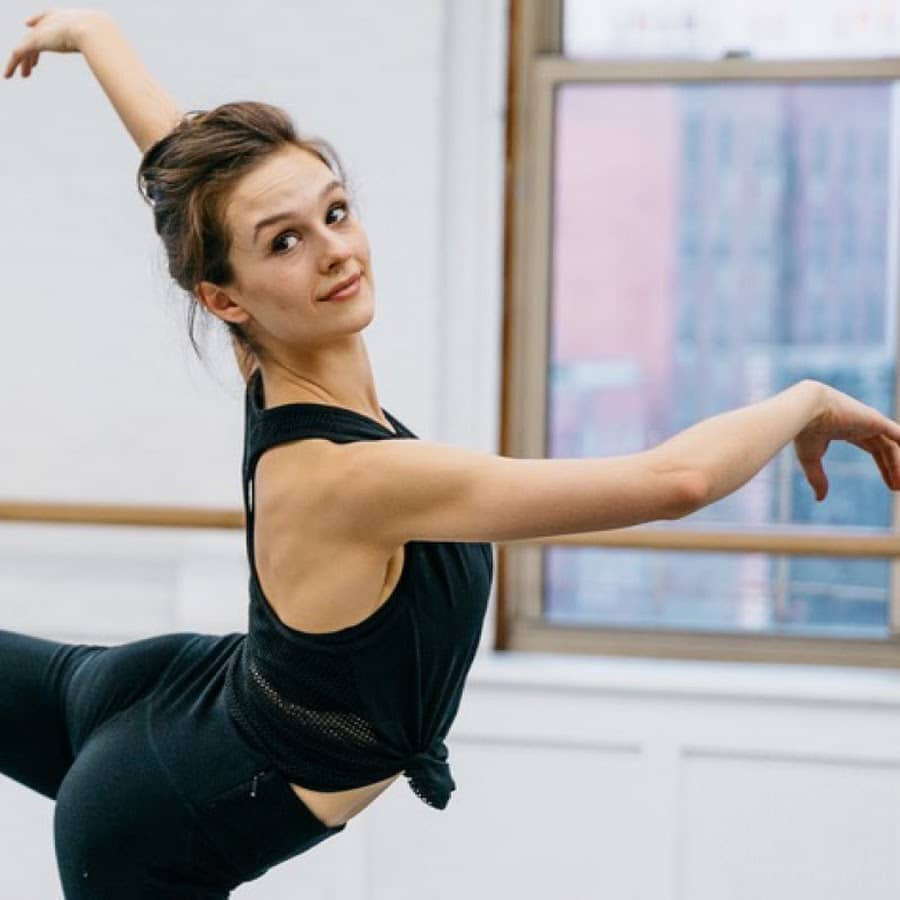
The word “pretentious” returns to mind about the choreography of Lauren Lovette (pictured). She has now been resident choreographer to the Paul Taylor dance company for three years : why? Choreographers usually at least show two basic reasons for creating dances. One, they show us why they’ve chosen this piece of music. Two, they show us what they like about these dancers. Lovette, however, seems at a loss; every Lovette work is the vaguest work performed by the Taylor troupe.
Fortunately – the three-week Taylor season at the horridly named David H. Koch Theater – ended on November 22 – there are dozens of Taylor’s own works to be revived. And at present they’re being well revived, even though few of today’s dancers worked with Taylor, and none at great length. One particular glory is “Beloved Renegade” (2008), a perfect example of Taylor’s weird originality. Who else would choose Poulenc’s “Gloria” (1959) as a setting for a work about the American poet Walt Whitman (1819-1892), looking back at the end of his life? Somehow Taylor arranges Whitman’s visions (which include an angel/muse) and memories (which include memories of the dead and dying in the American Civil War) to Poulenc’s religious score as if the conjunction were inevitable.
When it was young, it was said that Taylor saw “Beloved Renegade” as autobiographical, conducting rehearsals with great emotion. This season’s revival, the first with a new generation of dancers, is wonderfully fresh; it’s easy for us to watch it with no less emotion. Taylor’s drama is a changing kaleidoscope, at every point responding to pulses, harmonies, and melodies in Poulenc’s score, with changing avenues, diagonals and other stage geometries. Though Taylor’s earlier work does not include angel figures, we can at once see how this female angel is both his muse and his death. The male protagonist is principally an observer – a seer – but also a poet. These are his visions, his creations. “Beloved Renegade” remains the last masterpiece of Taylor’s long career. As always since its 2008 world premiere, I find myself brushing away tears in its final scenes.



Choreographing to entire well known pieces of non-dance music start to finish does seem a risky business. Being a glass half full type, I think of the successes, from Das Lied von Der Erde (MacMillan), Gorecki’s 3rd (Crystal Pite) and Music for 18 Musicians (de Keersmaeker). Beethoven is perhaps too familiar, but an all time favourite is Mats Ek’s “Bye” to the Arietta from Op. 111, to which Sylvie Guillem ended her career.
Do this too often (De K and Mark Morris) and it’ll go horribly wrong. De K got the worst headline I ever saw for a Biber thing, from The Times: “Mystery Sonatas / for Rosa review — a mind-numbingly boring endurance test”. I thought Debra Craine was being generous.
The “risky business” of choreographing ballet to non-dance music may indeed result in occasional pitfalls. But I can certainly think of myriad classical melodies that simply beg for dance. And some of the greatest choreographers took that metaphoric leap with resounding success: Think of Ashton’s marvelous take on Rachmaninov in “Rhapsody,” or Balanchine’s skill adapting Bizet (Palais de Cristal) and Mendelssohn (A Midsummer Night’s Dream) for the ballet stage. Just to name a few of the enduring successes. Some missteps may happen along the way. But nothing ventured, nothing gained.
I’m not sure Faure’s Requiem begged for the dance treatment, but MacMillan’s dedication to John Cranko is one of the most sublime things ever created, plus the William Blake imagery.
I was listening to the first release by a new Danish quartet last night on Qobuz. It starts with the Shostakovich war quartet no. 8. Cloud Gate from Taiwan used that unpromising piece for their last show called “Dust”. Marvellous, as always. Complicite once did a piece to the even less likely 15th Shostakovich quartet, played live on stage by the Chilingirian.
What about Macmillan’s Gloria, one of the most affecting ballets I have ever seen (to the Poulenc score). Or Rudi Van Dantzig’s astonishing Four Last Songs.
I know it is not respectable around here to like Philip Glass, but I got interested in his music when I saw Twyla Tharp’s In the Upper Room. The fusion of dance and music was breathtaking
Macmillan again: Elite Syncopations, a delightful illustration of the notes of a selection of Scott Joplin, which beautifully married movement and music.
You are quite right — not everything works. You couldn’t get me to Ashton’s Les Patineurs again at gunpoint (virtually alone of all his works, and I have seen many. I’d go to The Two Pigeons, as well as most of his better-known works, any day of the week).
The music is there; the success of the fusion depends largely upon the imaginative application of it by the choreographer. There was a year or two when every choreographer seemed to have tackled Gavin Bryars’ Jesus’ Blood. I was familiar with the piece, as CBC had done a wonderful interview with the composer. I saw at least three versions of it within one season, two of which I found inspiring, one that bored me to tears. I won’t name the one that failed me, but the one I liked the most was by James Kudelka. I am prepared to admit it could be a matter of taste, but it could also be that he made the best artistic choices with how to move his dancers to that song.
As long as there is music to be heard and choreographers who will create movement using it, every dance has wonderful possibilities.
I’ve seen and enjoyed Elite Syncopations. Jesus’ Blood is new to me. ‘Will have to check it out.
Balanchine did not have great skill, though he could play the piano; he thought that gave him license to violate any music he chose to, and violate he did.
Balanchine knew well what music NOT to choreograph. So he would do symphonies but cut the first movements (Scotch, Tchaikovsky 3rd) because sonata from doesn’t lend itself well to ballet. He knew what music to leave out of full-length ballet’s, such as his delightfully short “Swan Lake” which has “just the good parts,” musically speaking.
Ah yes. But for me the entire score of Swan Lake IS the good part. And in Symphony in C (Palais de Cristal), Balanchine did use Bizet’s entire work start to finish. To very wonderful effect, I might add.
Cartoons have been choreographing non-dance music for decades.
Don’t know who composed the headline for Alistair’s piece (was it you, Norman?), but it certainly fails to reflect anything in the in body of the article, surely the first necessity of a heading.
Why is the Koch Theater horribly named? Koch donated $100M towards its renovation. Why shouldn’t it be named for him?
This is a strange meandering piece of writing begging for an editor. It’s more an inventory of what was staged than a review. Why does it matter how Makarova danced a Van Manen piece fifty damn years ago?
Have you never read a music review that compares the young modern tackling a piece to some allegedly definitive version of it by a past master?
I suspect you are young. The young don’t get reference.
The musical standards of choreographers have been dropping ever since Balanchine made a number of bad choices. Even though she initially used records to find the right music, Agnes DeMille maintained a high standard.